Spatial Pathway Visualization
spatial_pathway_updated.RmdOverview
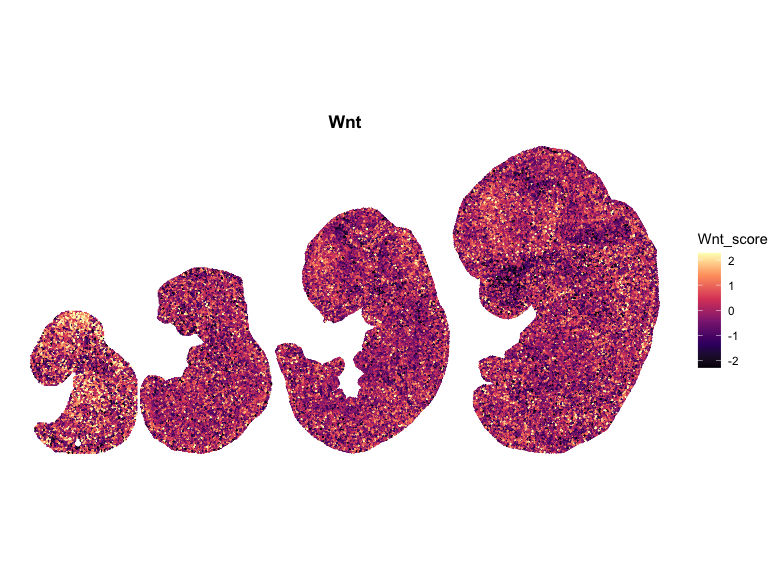
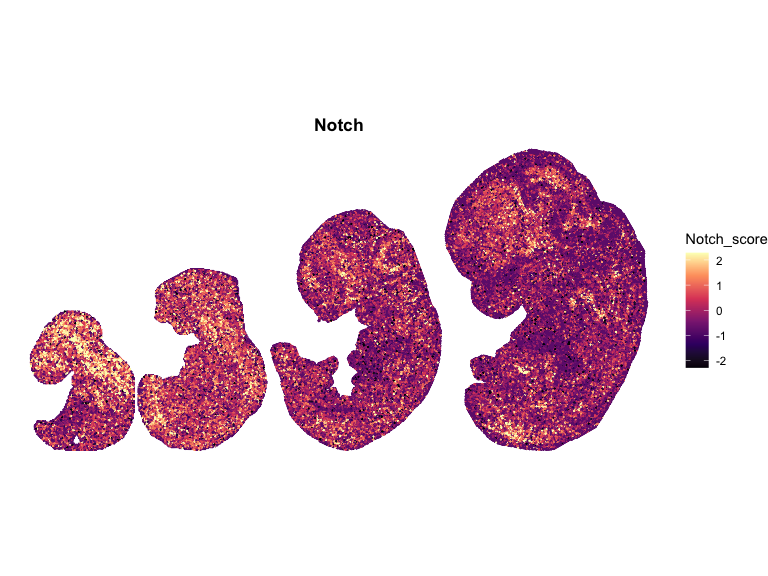
This vignette demonstrates the application of PathwayEmbed in mouse embryo spatial data (E9.5 - E12.5). With curated pathway database, we examined and compared Wnt, Notch, TGFb, Hippo, and HIF-1a signaling transduction states across spatial and temporal development. Reference for the initial data: Chen et al. Spatiotemporal transcriptomic atlas of mouse organogenesis using DNA nanoball-patterned arrays, Cell, Volume 185, Issue 10, 2022, Pages 1777-1792.e21.
knitr::opts_chunk$set(
  echo = TRUE,
  collapse = TRUE,
  warning = FALSE,
  message = FALSE,
  comment = "#>",
  fig.width = 8,
  fig.height = 6
)

# load library
library(PathwayEmbed)
library(Seurat)
## Warning: package 'Seurat' was built under R version 4.4.3## Loading required package: SeuratObject## Warning: package 'SeuratObject' was built under R version 4.4.3## Loading required package: sp## Warning: package 'sp' was built under R version 4.4.3##
## Attaching package: 'SeuratObject'## The following objects are masked from 'package:base':
##
## intersect, t## Warning: package 'ggplot2' was built under R version 4.4.3## Loading required package: viridisLite## Warning: package 'viridisLite' was built under R version 4.4.3## Warning: package 'dplyr' was built under R version 4.4.3##
## Attaching package: 'dplyr'## The following objects are masked from 'package:stats':
##
## filter, lag## The following objects are masked from 'package:base':
##
## intersect, setdiff, setequal, union## Warning: package 'Hmisc' was built under R version 4.4.3##
## Attaching package: 'Hmisc'## The following objects are masked from 'package:dplyr':
##
## src, summarize## The following object is masked from 'package:Seurat':
##
## Key## The following object is masked from 'package:SeuratObject':
##
## Key## The following objects are masked from 'package:base':
##
## format.pval, units## corrplot 0.95 loaded## Warning: package 'tibble' was built under R version 4.4.3## Warning: package 'tidyr' was built under R version 4.4.3Spatial data load and process
The files can be downloaded from figshare via below link:
Huang, Yaqing (2025). dat3.with.niches.norm.Robj. figshare. Dataset. https://doi.org/10.6084/m9.figshare.29649995.v1
Huang, Yaqing (2025). dat4.with.niches.norm.Robj. figshare. Dataset. https://doi.org/10.6084/m9.figshare.29649989.v1
Huang, Yaqing (2025). dat1.with.niches.norm.Robj. figshare. Dataset. https://doi.org/10.6084/m9.figshare.29649992.v1
Huang, Yaqing (2025). dat2.with.niches.norm.Robj. figshare. Dataset. https://doi.org/10.6084/m9.figshare.29649986.v1
# load data
load("dat1.with.niches.norm.Robj")
load("dat2.with.niches.norm.Robj")
load("dat3.with.niches.norm.Robj")
load("dat4.with.niches.norm.Robj")

# Merge together
merged_spatial <- merge(
  dat1, y = c(dat2, dat3, dat4))

# Set Default Assay to be "RNA"
DefaultAssay(merged_spatial) <- "RNA"

# Get genes x cell matrix
merged_spatial_matrix <- as.matrix(GetAssayData(merged_spatial, assay = "RNA", layer = "data"))

# Get metadata matrix
merged_spatial_metadata <- merged_spatial@meta.data
Get Pathway Data for Each Pathway first
# All Pathways
ListPathway("Pathway")
#> [1] "HIF1A" "HIPPO" "NOTCH" "TGFB"  "WNT"
ListPathway("HIF1A") # Pick Hypoxia_24hr
#> # A tibble: 3 × 8
#>   Pathway Sheet.Name GEO.Accession Condition Cell.Source Species No..Genes Notes
#>   <chr>   <chr>      <chr>         <chr>     <chr>       <chr>       <dbl> <chr>
#> 1 HIF1A   Hypoxia_6… GSE227502     Hypoxia … Primary hu… Human          21 NA
#> 2 HIF1A   Hypoxia_2… GSE227502     Hypoxia … Primary hu… Human          18 NA
#> 3 HIF1A   Hypoxia_5… GSE227502     Hypoxia … Primary hu… Human          10 NA
ListPathway("HIPPO") # Only one: HIPPO_heat
#> # A tibble: 1 × 8
#>   Pathway Sheet.Name GEO.Accession Condition Cell.Source Species No..Genes Notes
#>   <chr>   <chr>      <chr>         <chr>     <chr>       <chr>       <dbl> <chr>
#> 1 HIPPO   HIPPO_heat GSE133251     Heat str… B16-OVA me… Mouse          40 NA
ListPathway("NOTCH") # Use NOTCH_JAG1_24H -> validated in another datasets
#> # A tibble: 6 × 8
#>   Pathway Sheet.Name GEO.Accession Condition Cell.Source Species No..Genes Notes
#>   <chr>   <chr>      <chr>         <chr>     <chr>       <chr>       <dbl> <chr>
#> 1 NOTCH   NOTCH_JAG1 GSE223735     rJAG1 li… Mouse embr… Mouse           5 NA
#> 2 NOTCH   NOTCH_CB1… GSE221577     CB-103 N… RPMI-8402 … Human          46 NA
#> 3 NOTCH   NOTCH_LY_… GSE221577     LY411575… RPMI-8402 … Human          46 NA
#> 4 NOTCH   NOTCH_JAG… GSE235637     JAG1 sti… SVG-A cells Human          11 NA
#> 5 NOTCH   NOTCH_JAG… GSE235637     JAG1 sti… SVG-A cells Human          11 NA
#> 6 NOTCH   NOTCH_JAG… GSE235637     JAG1 sti… SVG-A cells Human          11 NA
ListPathway("TGFB") # Use TGFB_Mouse since this is the only Ms dataset
#> # A tibble: 3 × 8
#>   Pathway Sheet.Name GEO.Accession Condition Cell.Source Species No..Genes Notes
#>   <chr>   <chr>      <chr>         <chr>     <chr>       <chr>       <dbl> <chr>
#> 1 TGFB    TGFB_Huma… GSE110021     TGF-β1 t… WI-38 fibr… Human          35 NA
#> 2 TGFB    TGFB_Huma… GSE110021     TGF-β1 t… WI-38 fibr… Human          39 NA
#> 3 TGFB    TGFB_Mouse GSE246932     TGF-β1 t… T Cells     Mouse           9 NA
ListPathway("WNT") # Use WNT3A_SLOPE_ACTIVATION
#> # A tibble: 4 × 8
#>   Pathway Sheet.Name GEO.Accession Condition Cell.Source Species No..Genes Notes
#>   <chr>   <chr>      <chr>         <chr>     <chr>       <chr>       <dbl> <chr>
#> 1 WNT     WNT3A_12H… GSE103175     WNT3A tr… Human Embr… Human          90 NA
#> 2 WNT     WNT3A_24H… GSE103175     WNT3A tr… Human Embr… Human          88 NA
#> 3 WNT     WNT3A_48H… GSE103175     WNT3A tr… Human Embr… Human          90 NA
#> 4 WNT     WNT3A_SLO… GSE103175     WNT3A tr… Human Embr… Human          90 NA

# Load Each Pathwaydatabase
HIf1a_pathwaydata <- LoadPathway("Hypoxia_24hr", "mouse")
Hippo_pathwaydata <- LoadPathway("HIPPO_heat", "mouse")
Notch_pathwaydata <- LoadPathway("NOTCH_JAG1_24H", "mouse")
TGFb_pathwaydata <- LoadPathway("TGFB_Mouse", "mouse")
Wnt_pathwaydata <- LoadPathway("WNT3A_SLOPE_ACTIVATION", "mouse")
Calculation
Using Matrix extracted to avoid large size data object, compute score for Wnt, Notch, Hippo, Tgfb, and HIF-1a pathways for the merged subject using ‘ComputeCellData’ in PathwayEmbed
# DataPreProcess
matrix_HIf1a <- DataPreProcess(merged_spatial_matrix, HIf1a_pathwaydata, Seurat.object = FALSE)
matrix_Hippo <- DataPreProcess(merged_spatial_matrix, Hippo_pathwaydata, Seurat.object = FALSE)
matrix_Notch <- DataPreProcess(merged_spatial_matrix, Notch_pathwaydata, Seurat.object = FALSE)
matrix_TGFb <- DataPreProcess(merged_spatial_matrix, TGFb_pathwaydata, Seurat.object = FALSE)
matrix_Wnt <- DataPreProcess(merged_spatial_matrix, Wnt_pathwaydata, Seurat.object = FALSE)

# PathwayMaxMin
pathwaystat_HIf1a <- PathwayMaxMin(matrix_HIf1a, HIf1a_pathwaydata)
pathwaystat_Hippo <- PathwayMaxMin(matrix_Hippo, Hippo_pathwaydata)
pathwaystat_Notch <- PathwayMaxMin(matrix_Notch, Notch_pathwaydata)
pathwaystat_TGFb <- PathwayMaxMin(matrix_TGFb, TGFb_pathwaydata)
pathwaystat_Wnt <- PathwayMaxMin(matrix_Wnt, Wnt_pathwaydata)

# Computing Score
HIf1a_score <- ComputeCellData(matrix_HIf1a, pathwaystat_HIf1a)
Hippo_score <- ComputeCellData(matrix_Hippo, pathwaystat_Hippo)
Notch_score <- ComputeCellData(matrix_Notch, pathwaystat_Notch)
TGFb_score <- ComputeCellData(matrix_TGFb, pathwaystat_TGFb)
Wnt_score <- ComputeCellData(matrix_Wnt, pathwaystat_Wnt)
Prepare plot data
Map Timepoints back to the data
# Compute the score for each pathway
Wnt_to.plot <- PreparePlotData(merged_spatial_metadata, Wnt_score, "timepoint", Seurat.object = FALSE)
Notch_to.plot <- PreparePlotData(merged_spatial_metadata, Notch_score, "timepoint", Seurat.object = FALSE)
Hippo_to.plot <- PreparePlotData(merged_spatial_metadata, Hippo_score, "timepoint", Seurat.object = FALSE)
Tgfb_to.plot <- PreparePlotData(merged_spatial_metadata, TGFb_score, "timepoint", Seurat.object = FALSE)
HIF1a_to.plot <- PreparePlotData(merged_spatial_metadata, HIf1a_score,"timepoint", Seurat.object = FALSE)


# Combine to list
pathway_timepoint <- list(
  Wnt = Wnt_to.plot,
  Notch = Notch_to.plot,
  Hippo = Hippo_to.plot,
  Tgfb = Tgfb_to.plot,
  HIF1a = HIF1a_to.plot
)
Preparation for groups
#> /private/var/folders/dy/dxff9z6j5cdd5sqsvz2l5ngc0000gn/T/Rtmpmg02tW/temp_libpathdf927ed424e8/PathwayEmbed/extdata/pathway_list_timepoint.rds
#> /private/var/folders/dy/dxff9z6j5cdd5sqsvz2l5ngc0000gn/T/Rtmpmg02tW/temp_libpathdf927ed424e8 /Library/Frameworks/R.framework/Versions/4.4-arm64/Resources/library
# Color set-up
magma_colors <- c("#000004FF", "#721F81FF", "#F1605DFF", "#5A90E6")

# Desired timepoint order
ordered_timepoints <- c("E9.5", "E10.5", "E11.5", "E12.5")

# Reorder timepoint levels
for (name in names(pathway_timepoint)) {
  pathway_timepoint[[name]]$timepoint <- factor(pathway_timepoint[[name]]$timepoint, levels = ordered_timepoints)
}
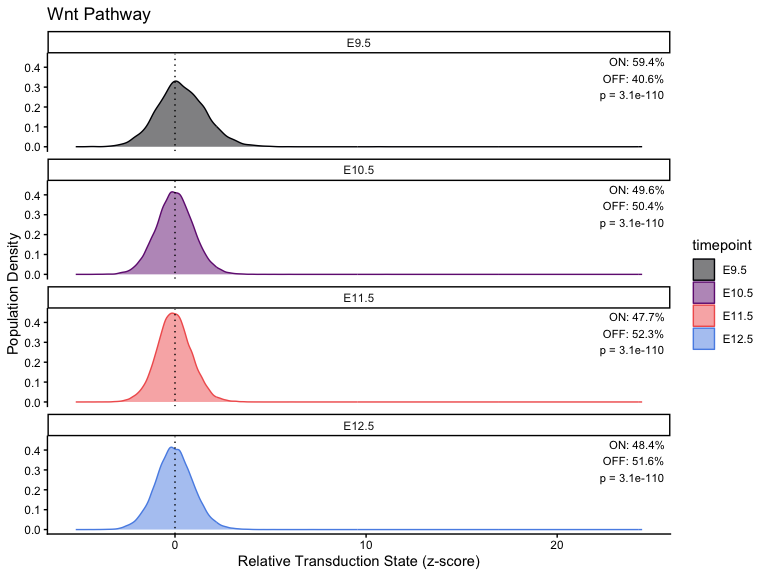
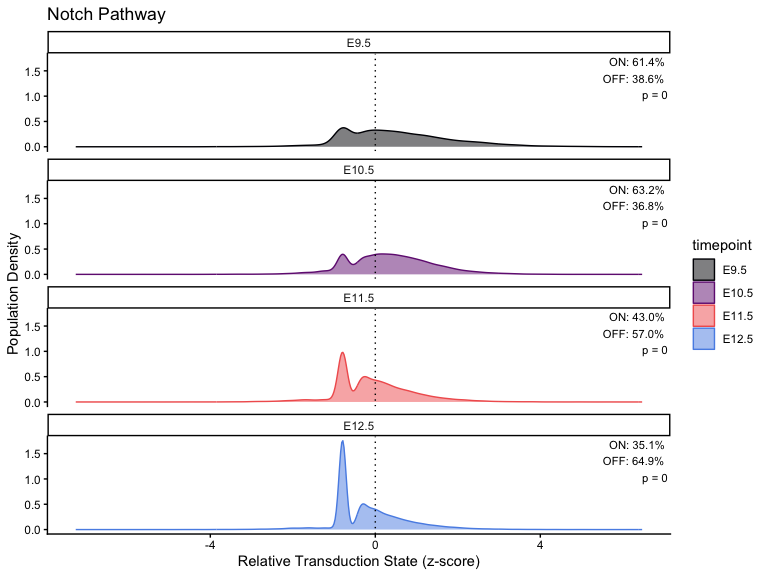
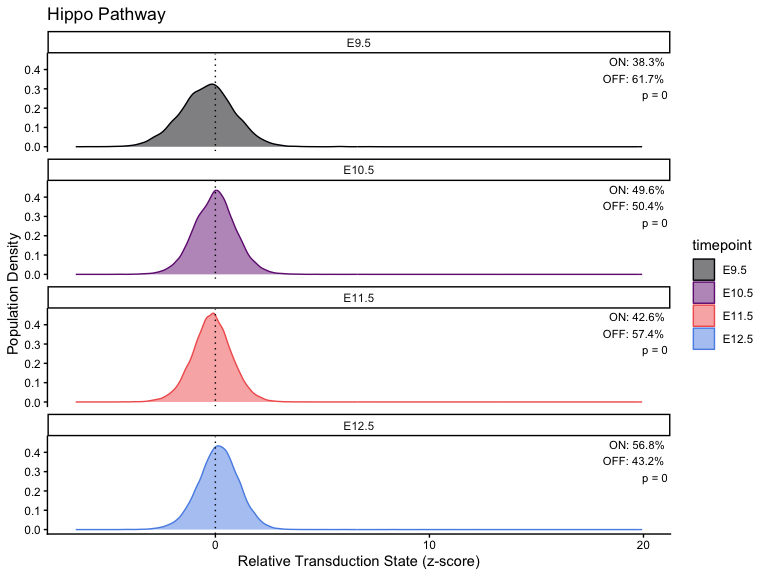
Plot across different timepoints
# Calculation

stats <- list()
# Loop through each pathway and generate/save the plot
for (i in seq_along(pathway_timepoint)) {
  stats[[i]] <- CalculatePercentage(pathway_timepoint[[i]], "timepoint")

  df_stats <- stats[[i]]

  df_stats <- stats[[i]] %>%
  dplyr::distinct(group, .keep_all = TRUE) %>%
  dplyr::rename(timepoint = group)

p <- PlotPathway(
  pathway_timepoint[[i]],
  names(pathway_timepoint)[i],
  "timepoint",
  magma_colors
) +
  facet_wrap(~factor(timepoint, levels = ordered_timepoints), ncol = 1) +
  geom_text(
    data = df_stats %>%
      mutate(timepoint = factor(timepoint, levels = ordered_timepoints)),
    aes(
      x = Inf,
      y = Inf,
      label = sprintf(
        "ON: %.1f%%\nOFF: %.1f%%\np = %.2g",
        percentage_on, percentage_off, kruskal_p
      )
    ),
    hjust = 1.1,
    vjust = 1.1,
    size = 3,
    inherit.aes = FALSE
  )

  print(p)
  # ggsave(
  #   filename = paste0(names(pathway_timepoint)[i], "_timepoint_plot.png"),
  #   plot = p,
  #   width = 6,
  #   height = 8,
  #   dpi = 300
#  )
}
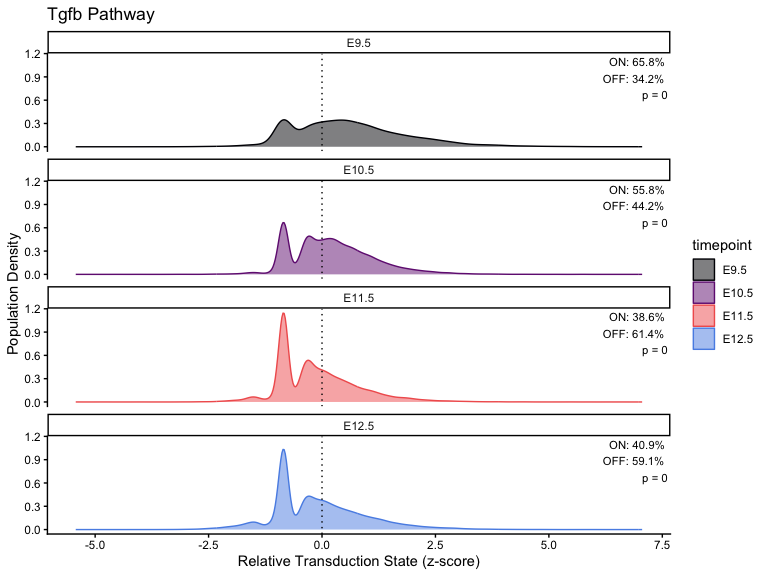
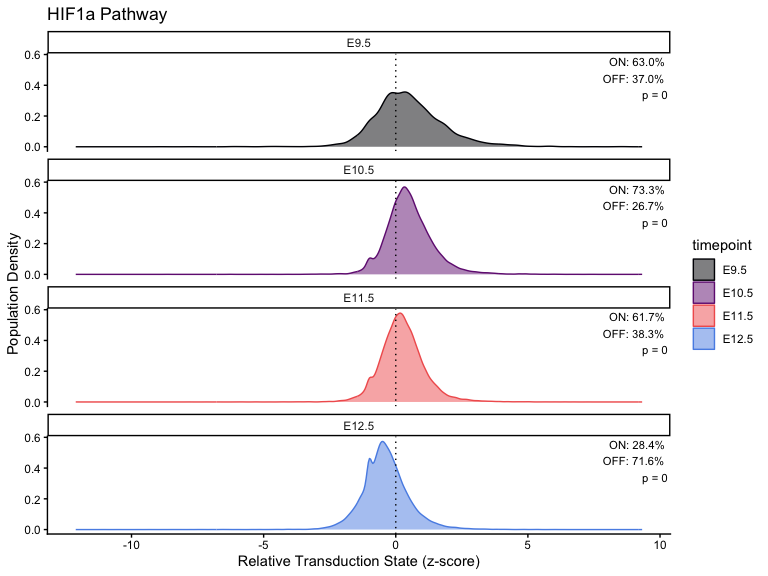
Merge score with original metadata
# Step 1: Create named score vectors for each pathway
score_list <- lapply(pathway_list, function(df) {
  s <- df$scale
  names(s) <- rownames(df)
  return(s)
})

# Step 2: Add each pathway score to dat1–dat4
for (i in 1:4) {
  dat <- get(paste0("dat", i))  # get dat1, dat2, ...

  for (pathway_name in names(score_list)) {
    score_vec <- score_list[[pathway_name]]
    dat[[paste0(pathway_name, "_score")]] <- score_vec[colnames(dat)]
  }

  assign(paste0("dat", i), dat)  # assign back to dat1, dat2, etc.
}


# List of Seurat objects
dat_list <- list(dat1, dat2, dat3, dat4)
names(dat_list) <- paste0("dat", 1:4)

# List of pathways
pathways <- names(pathway_list)  # e.g., "Wnt", "Notch", etc.
Extract the coordinates
# Function to extract
extract_pathway_df <- function(seu, pathway, sample_name = "sample") {
  coords <- as.data.frame(Embeddings(seu[["spatial"]]))
  colnames(coords) <- c("x", "y")
  coords$score <- seu[[paste0(pathway, "_score")]][rownames(coords), 1]
  coords$sample <- sample_name
  return(coords)
}

# Set list to save the coordinates
combined_df_lists <- list()

# For loop for all pathways
for (pathway in pathways) {
  pathway_df_list <- mapply(
    FUN = extract_pathway_df,
    seu = dat_list,
    sample_name = names(dat_list),
    MoreArgs = list(pathway = pathway),
    SIMPLIFY = FALSE
  )

  combined_df <- do.call(rbind, pathway_df_list)
  combined_df_lists[[pathway]] <- combined_df
}
Plot the spatial data
# Compute global symmetric limits (recommended)
all_values <- unlist(lapply(combined_df_lists, function(df) df$scale))
q <- quantile(all_values, c(0.02, 0.98), na.rm = TRUE)
max_abs <- max(abs(q))
global_limits <- c(-max_abs, max_abs)

for (pathway in names(combined_df_lists)) {

  combined_df <- combined_df_lists[[pathway]]
  # randomize the plot
  combined_df <- combined_df[sample(nrow(combined_df)), ]

  p <- ggplot(combined_df, aes(x = x, y = y, color = scale)) +
    geom_point(size = 0.01) +
    scale_color_viridis_c(
      option = "magma",
      limits = global_limits,  # symmetric across all pathways
      oob = scales::squish,
      name = paste0(pathway, "_score")
    ) +
    scale_y_reverse() +
    coord_fixed() +
    theme_void() +
    theme(
      legend.position = "right",
      plot.title = element_text(hjust = 0.5, face = "bold")
    ) +
    ggtitle(pathway)

  print(p)
}
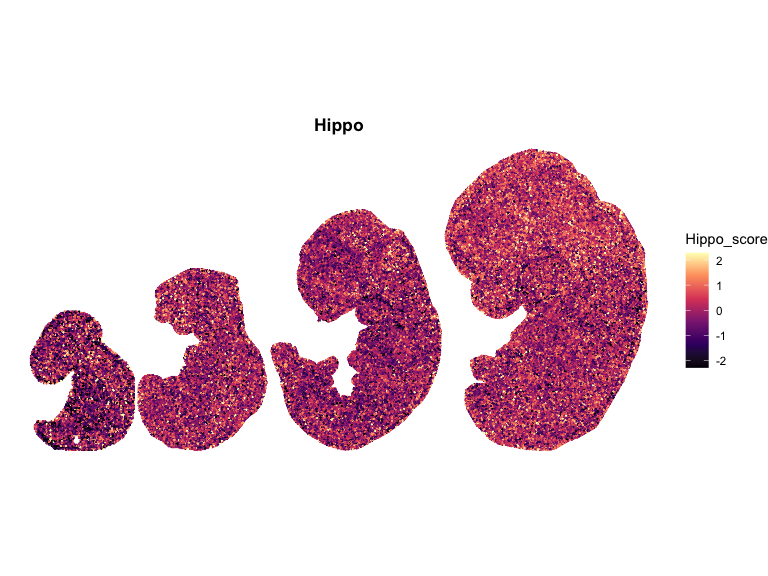
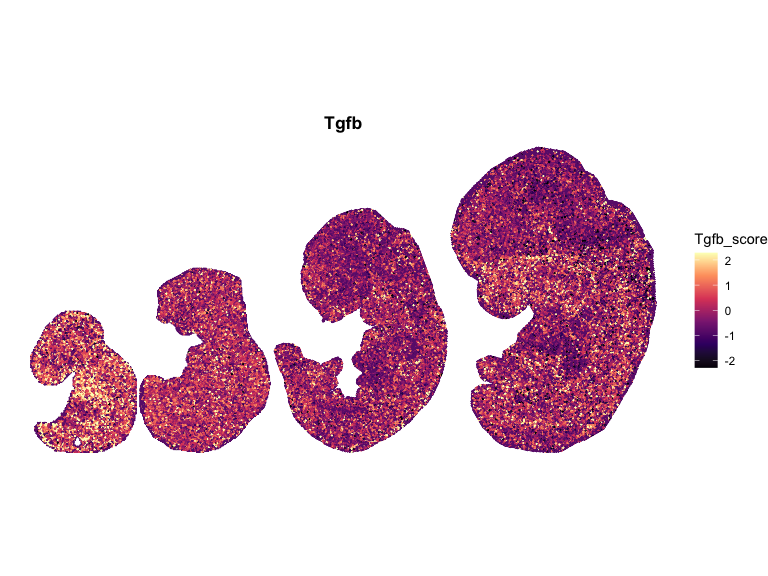
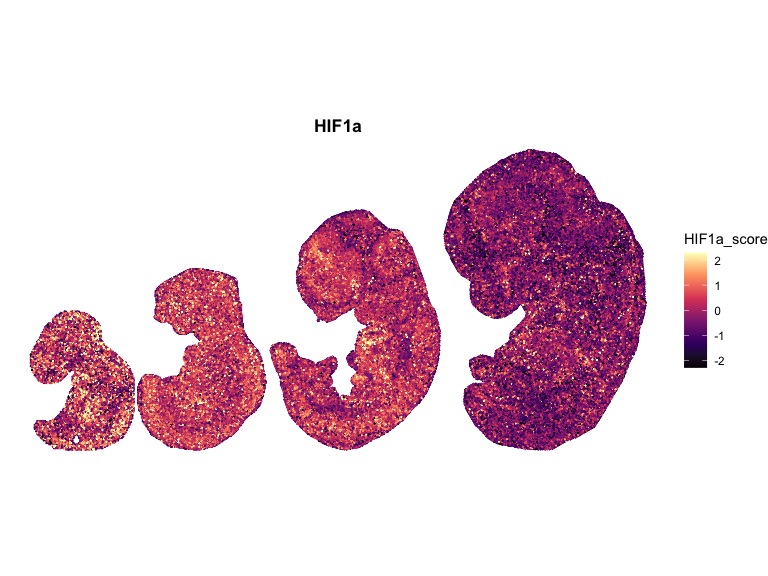 ## Spatial Correlation Analysis using Moran’s I
library(spdep)

# Global Moran's I

compute_morans_I <- function(df, k = 6) {

  coords <- as.matrix(df[, c("x", "y")])

  # k-nearest neighbors graph
  knn <- knearneigh(coords, k = k)
  nb  <- knn2nb(knn)
  lw  <- nb2listw(nb, style = "W")

  # Moran’s I test
  moran.test(df$scale, lw)
}

moran_results <- lapply(names(combined_df_lists), function(pw) {

  df <- combined_df_lists[[pw]]
  res <- compute_morans_I(df)

  data.frame(
    pathway = pw,
    morans_I = res$estimate[["Moran I statistic"]],
    p_value  = res$p.value
  )
})
moran_results <- do.call(rbind, moran_results)
print(moran_results)
#>   pathway   morans_I p_value
#> 1     Wnt 0.08640729       0
#> 2   Notch 0.21093640       0
#> 3   Hippo 0.09334557       0
#> 4    Tgfb 0.12592755       0
#> 5   HIF1a 0.25478622       0
# compute neighbor Moran's I for pathways with high spatial autocorrelation
compute_local_moran <- function(df, lw, pathway_name) {

  local <- localmoran(df$scale, lw)

  transform(
    df,
    local_I = local[, 1],
    z_score = local[, 4],
    p_value = local[, 5],
    pathway = pathway_name
  )
}

# Apply to selected pathways
selected_pathways <- c("Notch", "HIF1a")

df_plot <- do.call(rbind, lapply(selected_pathways, function(pw) {
  compute_local_moran(combined_df_lists_updated[[pw]], lw, pw)
}))
library(ggplot2)
library(viridis)

# 🔀 Randomize plotting order
df_plot <- df_plot[sample(nrow(df_plot)), ]

df_plot$cluster <- "Not significant"

df_plot$cluster[df_plot$p_value < 0.05 & df_plot$local_I > 0] <- "High-High"
df_plot$cluster[df_plot$p_value < 0.05 & df_plot$local_I < 0] <- "Low-Low"

df_plot$cluster <- factor(df_plot$cluster,
                          levels = c("High-High", "Low-Low", "Not significant"))

df_plot <- df_plot[sample(nrow(df_plot)), ]

p_cluster <- ggplot(df_plot, aes(x = x, y = y, color = cluster)) +
  geom_point(size = 0.001) +
  scale_color_manual(values = c(
    "High-High" = "#d73027",   # red = hotspot
    "Low-Low"   = "#4575b4",   # blue = coldspot
    "Not significant" = "grey80"
  )) +
  scale_y_reverse() +
  coord_fixed() +
  facet_wrap(~ pathway) +
  theme_void() +
  labs(title = "Local Moran’s I Clusters",
       color = "Cluster")

print(p_cluster)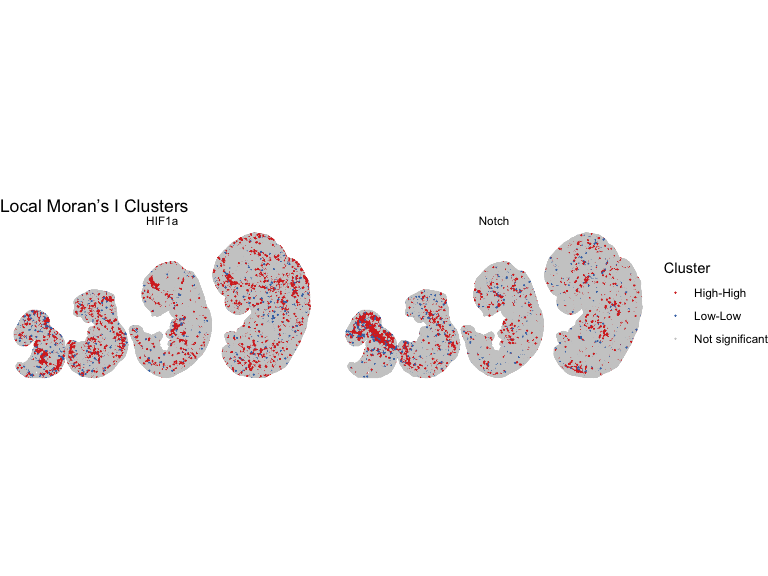
Benchmark towards Progeny
Benchmark + Technical Confounding Factors
set.seed(123)
# Load all required libraries
  library(progeny)
  library(ggplot2)
  library(dplyr)
  library(tidyr)
  library(patchwork)
  library(corrplot)
  library(Hmisc)
  library(Matrix)
  library(tibble)
library(tidyr)

# Explicitly import pipe in case dplyr loaded partially
`%>%` <- dplyr::`%>%`

# ----Progeny-----

merged_spatial_matrix <- readRDS("merged_spatial_matrix.rds")

progeny_scores <- progeny(
  merged_spatial_matrix,
  scale    = TRUE,
  organism = "Mouse",
  top      = 100,
  perm     = 1
)
# Extract pathways — check column names exist first
print(colnames(progeny_scores))
#>  [1] "Androgen" "EGFR"     "Estrogen" "Hypoxia"  "JAK-STAT" "MAPK"
#>  [7] "NFkB"     "p53"      "PI3K"     "TGFb"     "TNFa"     "Trail"
#> [13] "VEGF"     "WNT"

# Extract existed pathways
progeny_wnt     <- progeny_scores[, "WNT"]
progeny_hypoxia <- progeny_scores[, "Hypoxia"]
progeny_tgfb    <- progeny_scores[, "TGFb"]

# correlation with Progeny score
cor_wnt  <- cor(Wnt_score,   progeny_wnt,     use = "complete.obs", method = "spearman")
cor_tgfb <- cor(TGFb_score,  progeny_tgfb,    use = "complete.obs", method = "spearman")
cor_hif  <- cor(HIf1a_score, progeny_hypoxia, use = "complete.obs", method = "spearman")

cor_results <- data.frame(
  comparison  = c("Wnt vs PROGENy WNT", "TGFb vs PROGENy TGFb", "HIf1a vs PROGENy Hypoxia"),
  spearman_r  = round(c(cor_wnt, cor_tgfb, cor_hif), 4),
  pathway_our = c("Wnt_score", "TGFb_score", "HIf1a_score"),
  pathway_ref = c("WNT", "TGFb", "Hypoxia")
)

df_all <- rbind(
  data.frame(our = Wnt_score,   progeny = progeny_wnt,     pathway = "WNT"),
  data.frame(our = TGFb_score,  progeny = progeny_tgfb,    pathway = "TGFb"),
  data.frame(our = HIf1a_score, progeny = progeny_hypoxia, pathway = "Hypoxia")
)

label_df <- cor_results %>%
  mutate(pathway = c("WNT", "TGFb", "Hypoxia"),
         label   = paste0("r = ", round(spearman_r, 3)))

p_benchmark <- ggplot(df_all, aes(x = our, y = progeny)) +

  geom_point(alpha = 0.3, size = 0.8, color = "grey30") +

  geom_smooth(method = "lm", se = TRUE,
              color = "#E24B4A", fill = "#FAD4D4",
              linewidth = 0.8) +
  geom_text(
    data = label_df,
    aes(label = label),
    x = -Inf, y = Inf,
    hjust = -0.1, vjust = 1.2,
    size = 5,
    fontface = "bold",
    inherit.aes = FALSE
  ) +
  facet_wrap(~ pathway, ncol = 1, scales = "free_x") +
  labs(
    title = "Benchmark: Our Scores vs PROGENy",
    x = "Our pathway score",
    y = "PROGENy score"
  ) +
  theme_classic(base_size = 15) +
  theme(
    strip.background = element_rect(fill = "grey95", color = NA),
    strip.text = element_text(face = "bold"),
    plot.title = element_text(hjust = 0.5, face = "bold"),
    axis.title = element_text(face = "bold")
  )

p_benchmark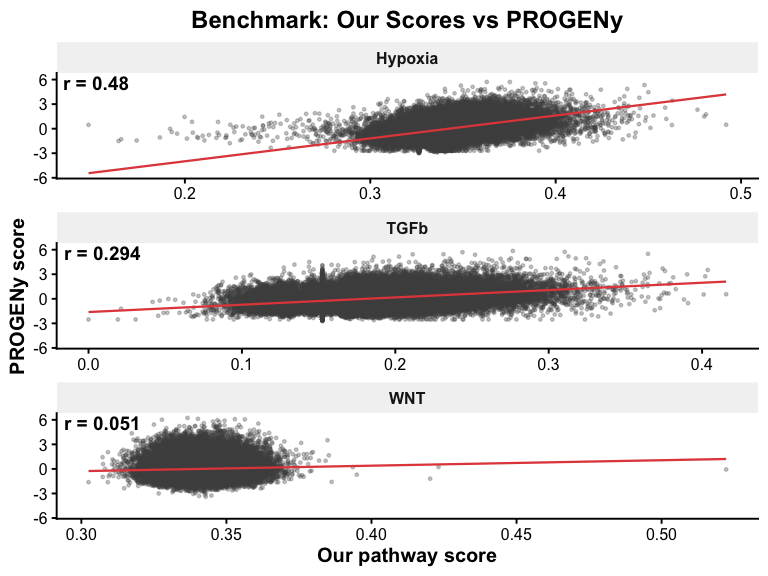
Cross-pathway Spearman Correlation matrix
score_df <- data.frame(
  HIf1a = HIf1a_score,
  Hippo = Hippo_score,
  Notch = Notch_score,
  TGFb  = TGFb_score,
  Wnt   = Wnt_score
)

cor_matrix <- cor(score_df, method = "spearman", use = "complete.obs")

cor_test <- Hmisc::rcorr(as.matrix(score_df), type = "spearman")
p_matrix <- cor_test$P
diag(p_matrix) <- 0  # rcorr sets diagonal to NA; corrplot requires numeric diagonal
print(round(cor_matrix, 3))
#>        HIf1a  Hippo  Notch   TGFb    Wnt
#> HIf1a  1.000 -0.088  0.118  0.078  0.033
#> Hippo -0.088  1.000 -0.041 -0.093 -0.036
#> Notch  0.118 -0.041  1.000  0.099  0.041
#> TGFb   0.078 -0.093  0.099  1.000  0.031
#> Wnt    0.033 -0.036  0.041  0.031  1.000

# Correlation heatmap

corrplot::corrplot(cor_matrix,
         method = "color", type = "upper",
         addCoef.col = "black", number.cex = 0.8,
         tl.col = "black", tl.srt = 45,
         p.mat = p_matrix, sig.level = 0.05, insig = "blank",
         title = "Pathway Spearman Correlations",
         mar   = c(0, 0, 2, 0))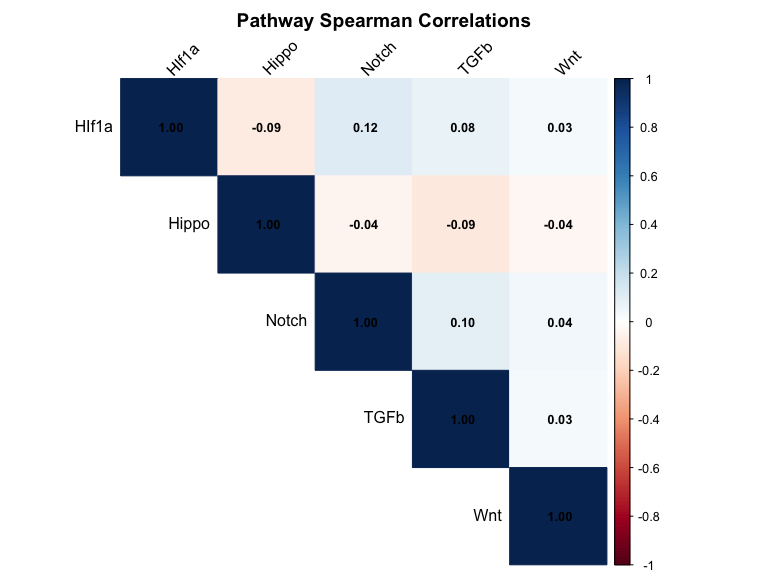
Technical Cofounders
#---Basic QC metrics from the raw count matrix ----
# merged_spatial_matrix is genes x spots (dense or sparse both work here)
nCount   <- Matrix::colSums(merged_spatial_matrix)
nFeature <- Matrix::colSums(merged_spatial_matrix > 0)

# Mitochondrial genes — mouse mt genes start with "mt-" (lowercase)
mt_genes  <- grep("^mt-", rownames(merged_spatial_matrix),
                  value = TRUE, ignore.case = TRUE)
if (length(mt_genes) == 0) {
  warning("No mitochondrial genes found. Check rowname format (expected 'mt-*').")
  pct_mt <- rep(NA_real_, ncol(merged_spatial_matrix))
} else {
  mt_counts <- Matrix::colSums(merged_spatial_matrix[mt_genes, , drop = FALSE])
  pct_mt    <- 100 * mt_counts / nCount
}


#---Cell Cycle Scoring----

# Strategy: compute the mean z-scored expression of S-phase genes and G2M
# genes per spot as module scores, then correlate with pathway scores.
# This is equivalent to Seurat's AddModuleScore but works on a plain matrix.

# Mouse cell cycle gene sets (Tirosh et al. 2015, mouse-converted)
s_genes_mouse <- c(
  "Mcm5", "Pcna", "Tyms", "Fen1", "Mcm7", "Mcm4", "Rrm1", "Ung",
  "Gins2", "Mcm6", "Cdca7", "Dtl", "Prim1", "Uhrf1", "Cenpu",
  "Hells", "Rfc2", "Rad51ap1", "Gmnn", "Wdc", "Slbp", "Ccne2",
  "Ubr7", "Pold3", "Msh2", "Atad2", "Rad51", "Rrm2", "Cdc45",
  "Cdc6", "Exo1", "Tipin", "Dscc1", "Blm", "Casp8ap2", "Usp1",
  "Clspn", "Pola1", "Chaf1b", "Brip1", "E2f8"
)

g2m_genes_mouse <- c(
  "Hmgb2", "Cdk1", "Nusap1", "Ube2c", "Birc5", "Tpx2", "Top2a",
  "Ndc80", "Cks2", "Nuf2", "Cks1b", "Mki67", "Ckap2l", "Ckap2",
  "Aurkb", "Bub1", "Kif11", "Anp32e", "Tubb4b", "Gtse1", "Kif20b",
  "Hjurp", "Cdca3", "Hn1", "Cdc20", "Ttk", "Cdc25c", "Kif2c",
  "Rangap1", "Ncapd2", "Dlgap5", "Cdca2", "Cdca8", "Ect2", "Kif23",
  "Hmmr", "Aurka", "Psrc1", "Anln", "Lbr", "Ckap5", "Cenpe",
  "Ctcf", "Nek2", "G2e3", "Gas2l3", "Cbx5", "Cenpa"
)

# Helper: compute mean z-scored module score per spot for a gene set.
# Works on a genes x spots matrix (dense or sparse).
# Returns a named numeric vector of length = ncol(mat).
compute_module_score <- function(mat, gene_set) {
  genes_present <- intersect(gene_set, rownames(mat))
  if (length(genes_present) == 0) {
    warning("No genes from gene set found in matrix.")
    return(rep(NA_real_, ncol(mat)))
  }
  if (length(genes_present) < length(gene_set)) {
    message("  Using ", length(genes_present), " / ", length(gene_set),
            " genes from gene set.")
  }
  sub_mat <- as.matrix(mat[genes_present, , drop = FALSE])
  # Row-wise z-score (across spots), then average per spot
  sub_z <- t(scale(t(sub_mat)))
  sub_z[is.nan(sub_z)] <- 0   # genes with zero variance -> score 0
  colMeans(sub_z, na.rm = TRUE)
}

s_score   <- compute_module_score(merged_spatial_matrix, s_genes_mouse)
g2m_score <- compute_module_score(merged_spatial_matrix, g2m_genes_mouse)
cc_score  <- s_score - g2m_score   # signed cell-cycle activity index


# ---- Stress / Immediate-Early Gene Score---
# Immediate-early response genes (Fos, Jun family, Hsps, Atf3, Ddit3) are
# strongly induced by dissociation stress and ambient RNA contamination.
# A high correlation between a pathway score and this module raises a red flag.

stress_genes_mouse <- c(
  # IEG
  "Fos","Jun","Junb","Atf3","Egr1",

  # ER stress / UPR
  "Ddit3","Atf4","Xbp1","Hspa5",

  # heat shock
  "Hspa1a","Hspa1b","Hsp90aa1",

  # oxidative
  "Gadd45a","Gadd45b","Gadd45g"
)

stress_score <- compute_module_score(merged_spatial_matrix, stress_genes_mouse)


# --Assemble confounder data frame---

spot_names <- names(Wnt_score)   # canonical spot order from PathwayEmbed scores

confounder_df <- data.frame(
  spot        = spot_names,
  # PathwayEmbed scores
  Wnt         = Wnt_score[spot_names],
  TGFb        = TGFb_score[spot_names],
  HIf1a       = HIf1a_score[spot_names],
  Hippo       = Hippo_score[spot_names],
  Notch       = Notch_score[spot_names],
  # QC metrics
  nCount      = nCount[spot_names],
  nFeature    = nFeature[spot_names],
  pct_mt      = pct_mt[spot_names],
  # Module scores
  S_score     = s_score[spot_names],
  G2M_score   = g2m_score[spot_names],
  CC_score    = cc_score[spot_names],
  Stress      = stress_score[spot_names],
  row.names   = spot_names,
  stringsAsFactors = FALSE)
pathway_cols    <- c("Wnt", "TGFb", "HIf1a", "Hippo", "Notch")
confounder_cols <- c("nCount", "nFeature", "pct_mt",
                     "S_score", "G2M_score", "CC_score", "Stress")

# Build a long-form correlation table
cor_rows <- lapply(pathway_cols, function(pw) {
  lapply(confounder_cols, function(cov) {
    complete_idx <- complete.cases(confounder_df[[pw]], confounder_df[[cov]])
    r <- cor(confounder_df[[pw]][complete_idx],
             confounder_df[[cov]][complete_idx],
             method = "spearman")
    # Two-sided p-value via t-approximation (valid for large n)
    n   <- sum(complete_idx)
    t_stat <- r * sqrt((n - 2) / (1 - r^2))
    pv <- 2 * pt(-abs(t_stat), df = n - 2)
    data.frame(pathway = pw, covariate = cov,
               spearman_r = round(r, 4),
               p_value    = pv,
               n_spots    = n,
               stringsAsFactors = FALSE)
  })
})
cor_table <- do.call(rbind, do.call(c, cor_rows))

# FDR correction across all pathway-covariate pairs
cor_table$p_adj_BH <- p.adjust(cor_table$p_value, method = "BH")
cor_table$significant <- cor_table$p_adj_BH < 0.05
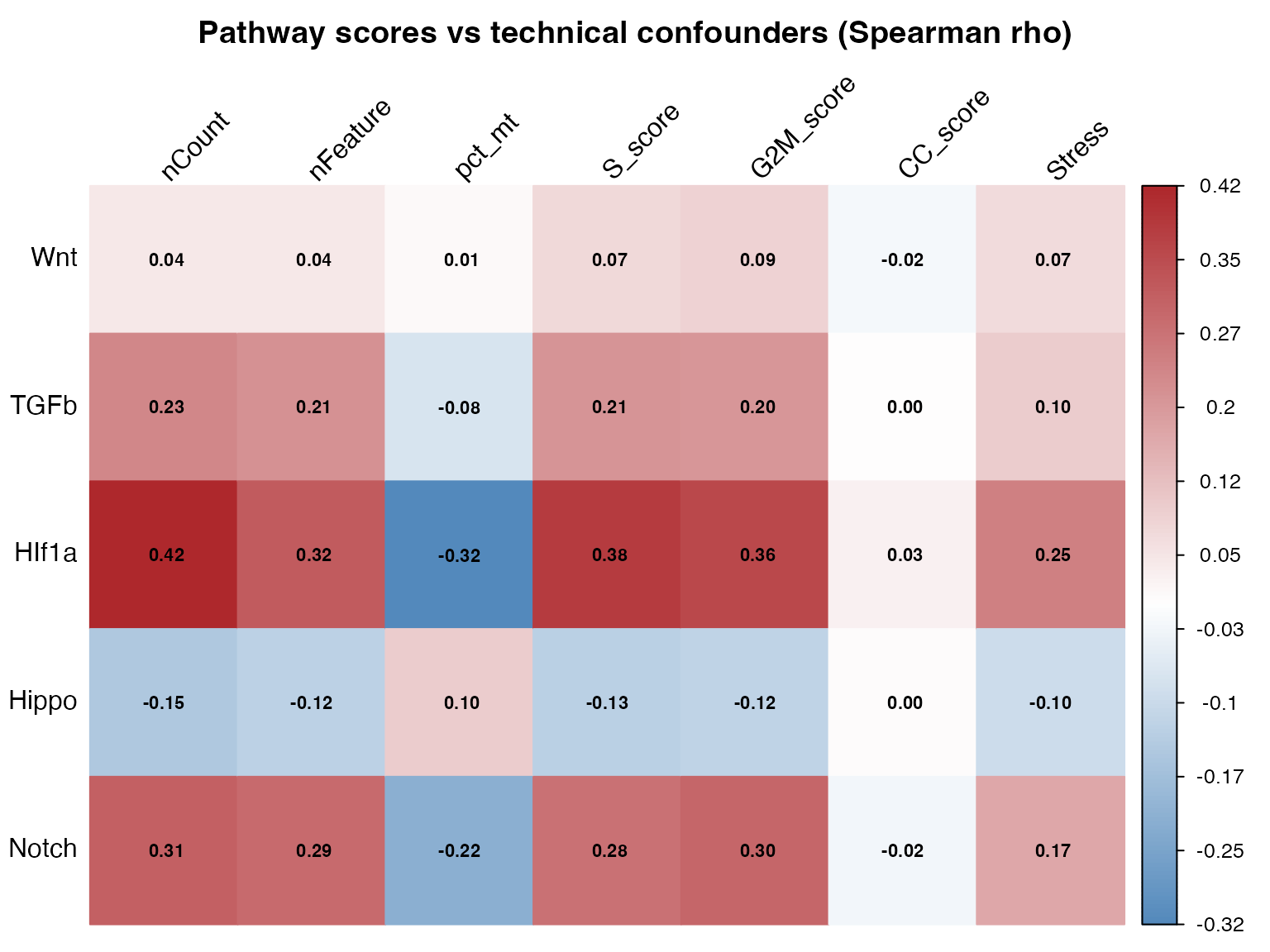
print(cor_table[, c("pathway", "covariate", "spearman_r", "p_adj_BH", "significant")])
#>    pathway covariate spearman_r      p_adj_BH significant
#> 1      Wnt    nCount     0.0433  4.415180e-45        TRUE
#> 2      Wnt  nFeature     0.0426  1.536189e-43        TRUE
#> 3      Wnt    pct_mt     0.0125  5.228341e-05        TRUE
#> 4      Wnt   S_score     0.0735 1.130319e-126        TRUE
#> 5      Wnt G2M_score     0.0871 6.075138e-177        TRUE
#> 6      Wnt  CC_score    -0.0199  9.980877e-11        TRUE
#> 7      Wnt    Stress     0.0684 8.929403e-110        TRUE
#> 8     TGFb    nCount     0.2328  0.000000e+00        TRUE
#> 9     TGFb  nFeature     0.2108  0.000000e+00        TRUE
#> 10    TGFb    pct_mt    -0.0755 1.735223e-133        TRUE
#> 11    TGFb   S_score     0.2074  0.000000e+00        TRUE
#> 12    TGFb G2M_score     0.2050  0.000000e+00        TRUE
#> 13    TGFb  CC_score     0.0002  9.384768e-01       FALSE
#> 14    TGFb    Stress     0.0996 2.252103e-231        TRUE
#> 15   HIf1a    nCount     0.4212  0.000000e+00        TRUE
#> 16   HIf1a  nFeature     0.3167  0.000000e+00        TRUE
#> 17   HIf1a    pct_mt    -0.3226  0.000000e+00        TRUE
#> 18   HIf1a   S_score     0.3803  0.000000e+00        TRUE
#> 19   HIf1a G2M_score     0.3572  0.000000e+00        TRUE
#> 20   HIf1a  CC_score     0.0261  2.706127e-17        TRUE
#> 21   HIf1a    Stress     0.2466  0.000000e+00        TRUE
#> 22   Hippo    nCount    -0.1506  0.000000e+00        TRUE
#> 23   Hippo  nFeature    -0.1228  0.000000e+00        TRUE
#> 24   Hippo    pct_mt     0.1003 2.944881e-234        TRUE
#> 25   Hippo   S_score    -0.1268  0.000000e+00        TRUE
#> 26   Hippo G2M_score    -0.1192  0.000000e+00        TRUE
#> 27   Hippo  CC_score     0.0047  1.274208e-01       FALSE
#> 28   Hippo    Stress    -0.0960 8.909423e-215        TRUE
#> 29   Notch    nCount     0.3083  0.000000e+00        TRUE
#> 30   Notch  nFeature     0.2871  0.000000e+00        TRUE
#> 31   Notch    pct_mt    -0.2177  0.000000e+00        TRUE
#> 32   Notch   S_score     0.2753  0.000000e+00        TRUE
#> 33   Notch G2M_score     0.2975  0.000000e+00        TRUE
#> 34   Notch  CC_score    -0.0247  9.902323e-16        TRUE
#> 35   Notch    Stress     0.1689  0.000000e+00        TRUE

cor_wide <- cor_table %>%
  select(pathway, covariate, spearman_r) %>%
  tidyr::pivot_wider(names_from = covariate, values_from = spearman_r) %>%
  tibble::column_to_rownames("pathway") %>%
  as.matrix()

sig_wide <- cor_table %>%
  select(pathway, covariate, significant) %>%
  tidyr::pivot_wider(names_from = covariate, values_from = significant) %>%
  tibble::column_to_rownames("pathway") %>%
  as.matrix()

# Build asterisk annotation matrix: * = FDR < 0.05, blank otherwise
annot_wide <- ifelse(sig_wide, "*", "")

# Use corrplot for the heatmap (consistent with cross-pathway section)

corrplot::corrplot(
  cor_wide,
  method      = "color",
  is.corr     = FALSE,           # raw values, not a correlation matrix
  col         = colorRampPalette(c("#2066a8", "white", "#ae282c"))(200),
  cl.lim      = c(-1, 1),
  addCoef.col = "black",
  number.cex  = 0.7,
  tl.col      = "black",
  tl.srt      = 45,
  title       = "Pathway scores vs technical confounders (Spearman rho)",
  mar         = c(0, 0, 2, 0)
)